
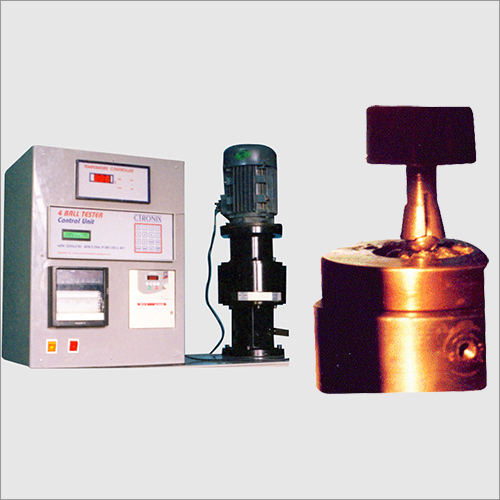
Composite 4 Ball Tester
450000.00 INR/Piece
Product Details:
- Specimen Size 12.7 mm diameter balls
- Temperature Room temperature to 200C (adjustable)
- Measuring Range 40400 kg
- Max Height Approx. 600 mm
- Equipment Type Composite 4 Ball Tester
- Port Size Standard sample cup size as per ASTM
- Accuracy 1% of load
- Click to View more
X
Composite 4 Ball Tester Price And Quantity
- 1 Piece
- 400000.00 - 600000.00 INR/Piece
- 450000.00 INR/Piece
- USB data transfer optional
- Overload protection, automatic stop at test end
- Optional optical measurement
- Dead weight loading system
- 10 ml per test
- Precision electrical heater with temperature control
- Up to 200°C
- ASTM D2266, ASTM D2596
- Optional air cooling available
Composite 4 Ball Tester Product Specifications
- 12.7 mm diameter balls
- 40400 kgf
- Room temperature to 200C (adjustable)
- Fixed stroke, as per ASTM D2266
- Composite 4 Ball Tester
- 40400 kg
- Approx. 600 mm
- 230V AC, 50 Hz
- 1% of load
- Standard sample cup size as per ASTM
- Digital microprocessor-based
- Digital interface
- Semi-automatic
- Ball hardness: HRC 6466
- Laboratory testing of lubricants
- Ambient
- 50 Hz
- Evaluation of extreme pressure and anti-wear properties of lubricants
- Microprocessor control, digital display, temperature controller
- Immediate, real-time
- 4 balls per test
- 1 kg
- Digital
- Bench-top
- 230V AC
- 1200 rpm
- Load range 40400 kg
- Approx. 40 kg
- USB data transfer optional
- Overload protection, automatic stop at test end
- Optional optical measurement
- Dead weight loading system
- 10 ml per test
- Precision electrical heater with temperature control
- Up to 200°C
- ASTM D2266, ASTM D2596
- Optional air cooling available
Composite 4 Ball Tester Trade Information
- Kolkata
- Cash on Delivery (COD), Cash in Advance (CID)
- 1 Piece Per Month
- 1 Days
- Asia
- All India
Product Description
The Four Ball Tester isa quality check instrument for lubricants and additives. The unique sample configuration of three bottom balls and one top ball makes a very stable and a repeatable contact in-turn, allowing tests results to be very repeatable.Advanced Testing Capabilities
This equipment applies rigorous methods to analyze lubricants under exacting conditions, measuring their resistance to wear and pressure. Featuring a microprocessor-based control system and digital display, it processes test samples of up to 10 ml with real-time accuracy, supporting both standard and custom evaluations as per international benchmarks.
Safety and Ease of Operation
Equipped with overload protection and automatic test termination, the tester promotes safe laboratory use. Optional air cooling and surface finish measurement facilitate flexibility, while digital interface and bench-top design ensure seamless integration and straightforward handling by laboratory personnel.
Compliance and Performance
Conforming to ASTM D2266 and ASTM D2596, the Composite 4 Ball Tester assures researchers of standardized results, essential for lubricant development and quality assurance. Its robust build and capacity range allow repeated, high-load testing with precise control over speed and measurement parameters.
FAQs of Composite 4 Ball Tester:
Q: How does the Composite 4 Ball Tester evaluate lubricant performance?
A: It applies specific loads using a dead weight mechanism to four precision balls, as per ASTM D2266 and D2596 standards, heating the sample up to 200C and measuring wear under controlled, real-time conditions.Q: What volume of lubricant sample is required for each test?
A: Each test requires approximately 10 ml of lubricant, ensuring efficient use for repeatable laboratory assessments.Q: When should optional features such as air cooling or surface finish measurement be considered?
A: These options are useful when precise temperature regulation is needed or detailed post-test wear analysis is desirable, especially for advanced R&D or quality control purposes.Q: Where is this tester typically installed and used?
A: It is designed for laboratory bench-top mounting, ideal for lubricant manufacturers, suppliers, and research institutions seeking robust, standardized testing.Q: What process does the machine follow for a standard test?
A: The operator places four HRC 6466 balls in the standard cup, loads the lubricant sample, sets test parameters via digital controls, and initiates the automatic test cycle which runs at 1200 rpm for a fixed stroke, with data recorded digitally.Q: How does using this equipment benefit lubricant analysis?
A: It delivers accurate, consistent measurements of extreme pressure and anti-wear properties, complies with ASTM standards, and supports quick data transfer for efficient reporting and product development.Q: What safety measures are built into the Composite 4 Ball Tester?
A: It incorporates overload protection and automatically stops at the end of each test, minimizing risk and ensuring safe laboratory operation.Tell us about your requirement

Price:
Quantity
Select Unit
- 50
- 100
- 200
- 250
- 500
- 1000+
Additional detail
Mobile number
Email

Other Products in 'Petroleum Testing Instruments' category


Contact Us

- Mr Prabir Kumar Sircar (Proprietor)
- Mobile : 07313726688
- Mr. Shome Shankar Sircar
- Mobile : 07313726688
-
 Send Inquiry
 Send Inquiry
- BNo 37A ,CHAKRABERE LANE,Kolkata - 700003, West Bengal, India
- Phone : 07313726688
C TRONIX
AN ISO 9001:2008 COMPANY
AN ISO 9001:2008 COMPANY

C TRONIX
All Rights Reserved.(Terms of Use)
Developed and Managed by Infocom Network Private Limited.
Developed and Managed by Infocom Network Private Limited.

